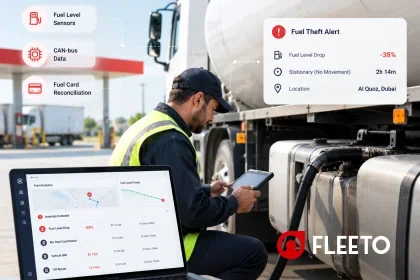
Fuel is usually the largest controllable cost in a fleet, and it's also where losses are hardest to pin down. A tank doesn't tell you who emptied it, a receipt doesn't tell you where the fuel went, and a driver's explanation is hard to test. A GPS and telematics platform can narrow the problem dramatically, but it's worth being clear about what the data proves and what it only suggests, because acting on a weak alert can cost more in trust than the theft costs in fuel.
Three ways to see fuel
Fuel level sensors in the tank. Capacitive or ultrasonic probes give a direct level reading. They detect sudden drops, fills and slow leaks, and they are the best tool for catching siphoning because they measure what is physically in the tank rather than what the vehicle reports.
CAN-bus and OBD data. Reading fuel level or consumption from the vehicle's own systems is simpler to install and works well on many modern vehicles, but accuracy depends on how the manufacturer reports the value, and some vehicles smooth the reading in ways that hide short events.
Fuel card reconciliation. Comparing what was paid for with what the vehicle actually received and consumed closes the loop between the finance record and the physical one. A fill on the card with no matching level increase is one of the clearest signals there is.
What an anomaly looks like
● A rapid level drop while the vehicle is stationary, especially out of hours or away from any known location
● Fills that don't match the card transaction, or fuel purchased with no corresponding level increase
● Consumption well above a vehicle's own normal range for similar routes and loads
● Excessive idling or off-route driving that burns fuel without delivering work
Individually, each of these has innocent explanations. Together, and repeated, they form a pattern worth investigating.
What the data can't prove
Be careful here. A level drop is evidence that fuel left the tank, not of who took it or why. Sensor noise from sloshing on slopes, temperature effects and partially filled tanks all produce false alarms. A consumption spike might be theft, a mechanical fault, a heavier load, or an air-conditioning-heavy summer route in Gulf temperatures. Treat alerts as a reason to look closer, not as a verdict.
This matters because the cost of a wrong accusation is high. An honest driver confronted with a bad alert loses trust in the whole system, and word spreads quickly. The right response to an alert is a quiet check of the evidence, a conversation, and a physical inspection where needed.
Making alerts useful
Calibrate sensors per vehicle and re-check them after any tank work, since calibration drifts and a mis-calibrated sensor generates a steady stream of false positives.
Use thresholds tuned to each vehicle's baseline so dispatchers aren't flooded. An alert that fires daily teaches people to ignore it.
Combine signals. A level drop while stationary at night, away from base, with no fuel card transaction, is far stronger than any single reading on its own.
Keep the evidence trail. Timestamps, location, level readings, trip data and the card record should all be retrievable together, so a conclusion can be explained and defended to a driver, a manager or an insurer.
Why choose Fleeto
Fleeto supports fuel level sensors and CAN-bus data on the same dashboard, with anomaly detection against each vehicle's own baseline rather than a fleet-wide average. Every alert links to the underlying trip and location evidence, and fuel card reconciliation closes the loop between what was bought and what was used. For white-label partners, that means offering clients fuel control that holds up when it is questioned.
Fleeto's fleet management software gives operators fuel alerts with evidence behind them, not just numbers on a chart