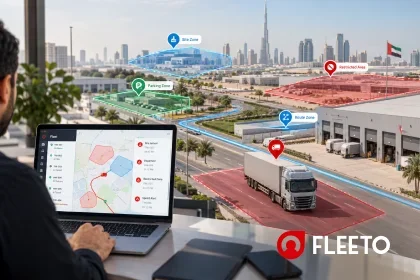
. Used properly, though, geofencing is one of the most practical tools a fleet manager has, because it turns raw location data into events that mean something to the business: a vehicle arrived, a vehicle left, a vehicle went somewhere it should not.
Why simple circles fall short
A circle is easy to draw and easy to get wrong. In dense urban areas, a circle around a client site may also cover the neighbouring street, a car park or a competitor's yard, triggering false arrivals. GPS drift near tall buildings adds noise. And a single zone per site ignores the fact that what matters often differs between the gate, the loading bay and the yard.
Better results come from shaping zones to the real world and attaching clear rules to each one.
Zone types worth setting up
Site arrival and departure. The classic use. Draw a polygon that follows the actual boundary of the depot, customer site or labour camp rather than a rough circle. Arrival and departure events can feed proof-of-visit records and automatic timesheets.
Customer delivery zones. Smaller zones around delivery addresses, with a minimum dwell time, confirm that a vehicle genuinely stopped rather than drove past. This is strong evidence in a delivery dispute.
Restricted and no-go areas. Zones around areas a vehicle should not enter, such as residential neighbourhoods for heavy trucks or restricted sites, with an immediate alert on entry.
Corridor or route zones. A buffer around an approved route flags deviations, which helps with cash-in-transit, school transport, fuel tankers and any high-value load.
Parking and overnight zones. Confirm that vehicles are parked at the approved location after hours and flag movement outside permitted times.
Speed-limited zones. Apply a lower speed threshold inside a site, camp or port area where the posted road limit does not apply.
Rules that make alerts useful
Combine location with time. A vehicle inside the depot at midnight is normal. A vehicle leaving it at midnight on a Friday may not be. Time windows turn a location event into a meaningful one.
Add dwell thresholds. Ignore passes through a zone shorter than a set number of minutes, and flag stops that run too long. This removes most false positives.
Use entry and exit conditions separately. You may want an alert on exit from a customer zone only when the delivery was not marked complete.
Assign the right recipient. The dispatcher needs arrivals and delays, the fleet manager needs restricted-zone breaches, and a customer-service team may want estimated-arrival updates. One alert stream for everyone becomes no stream for anyone.
Group vehicles sensibly. Apply rules by vehicle class, contract or driver group so a single change does not have to be repeated fifty times.
Keep zones maintained
Sites move, roads change, and contracts end. Review zones on a regular schedule, retire unused ones and test new ones with a real vehicle before relying on them. Check how the platform handles overlapping zones, so a vehicle in two zones at once triggers the right behaviour.
Consider privacy too. Driver tracking outside working hours raises legitimate questions, so set clear policies on when location is monitored and communicate them openly, in line with local requirements.
Turn events into reports
The value compounds when zone events feed reports: time on site per customer, depot turnaround, idle time at loading bays, route compliance and after-hours use. These are the numbers that support billing, planning and contract negotiation.
Why choose Fleeto
Fleeto supports polygon and route-corridor geofences with time windows, dwell thresholds and per-group rules, and routes alerts to the right people instead of everyone. Zone events flow straight into timesheets, proof-of-visit and utilisation reports, and the white-label platform lets partners configure zone templates for each client.
Fleeto is a white label GPS tracking software platform built to turn location data into zone rules that fleets actually act on.