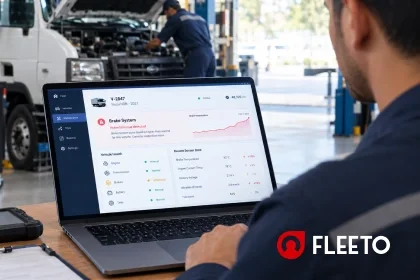
"Predictive maintenance" has become a checkbox feature on fleet platform comparison sheets, sitting next to live tracking and geofencing as if it's the same kind of thing to build. It isn't. A platform can track a vehicle in real time and still be doing nothing more than reactive maintenance with a nicer interface — a mileage-based service reminder is not a prediction, it's a calendar.
What reactive maintenance actually looks like, even when it's disguised as more
Most fleet platforms handle maintenance one of two ways: scheduled reminders based on mileage or time intervals, or alerts triggered after a fault code has already been thrown by the vehicle's OBD system. Both are useful. Neither is predictive. A mileage-based reminder doesn't know whether a specific vehicle's brake pads are wearing faster than the fleet average because of the routes it runs. A fault-code alert only fires after something has already gone wrong enough to trip a diagnostic threshold — which for some failure modes is well past the point where a cheap fix was still possible.
Genuine prediction means flagging that something is likely to fail before any fault code exists to flag it.
What real prediction requires
A behavioural and diagnostic baseline per vehicle, not a fleet-wide average. Two identical vehicle models running different routes — one on highway miles, one on stop-start city delivery — wear differently. A predictive system needs enough historical telemetry per individual vehicle to know what "normal" looks like for that specific asset, not just the model, before it can flag a deviation as meaningful.
Continuous OBD and CAN-bus data, not periodic snapshots. Predicting a failure before a fault code fires means watching the trend in the underlying sensor data — voltage drift, temperature patterns, vibration signatures — continuously, not sampling it every few hours. This is a hardware and data-pipeline requirement as much as an algorithm requirement: the device needs to be capturing the right granularity of data for the model to have anything to work with.
Enough failure history to actually train on. A prediction model is only as good as the failures it's learned from. A platform that's only ever logged scheduled services and fault-code alerts, with no structured record of what actually failed and when relative to the sensor trend beforehand, doesn't have the training data to predict anything — it's making assumptions dressed up as predictions.
A cost-aware alert threshold. Flagging every minor deviation as a predicted failure trains fleet managers to ignore the alerts within a month. A useful predictive system needs a threshold tuned to genuine, actionable risk — the difference between "this is worth a technician's time to check" and "this is normal variation for this vehicle on this route."
Where this actually pays off
The economic case for predictive over reactive maintenance isn't abstract — it's the difference between a planned, scheduled repair during a low-utilization window and an unplanned breakdown mid-route that costs a missed delivery, a recovery truck, and an emergency repair at a premium rate. For mixed fleets running EVs alongside ICE vehicles, prediction extends to battery health and degradation trends too, not just mechanical wear — a genuinely different data problem that a platform built only for combustion engines won't handle well.
The honest caveat
No predictive system eliminates unplanned breakdowns entirely — tyre punctures and collision damage aren't predictable from telemetry trends, and no vendor claiming otherwise is being straight with you. What a genuinely predictive system does is shift the proportion of maintenance events from unplanned to planned, which is where the real cost savings live.
Why choose Fleeto
Fleeto's Robotic Eye runs continuous anomaly detection against a learned baseline per vehicle, not a fleet-wide average, and surfaces genuine exceptions — fuel drain, anomalous idle patterns, sensor drift — rather than flooding dispatchers with alerts they learn to ignore. Predictive maintenance sits alongside EV battery health and range prediction on the same dashboard, so mixed ICE and EV fleets get one coherent view instead of two disconnected tools.
Fleeto's fleet management software is built around continuous per-vehicle telemetry, not periodic snapshots, which is what genuine prediction actually requires.